
Time calculations are a part of our daily lives, even if we don’t always realize it. Whether you’re trying to figure out when an event happened, tracking work hours, or simply satisfying curiosity, knowing how to calculate time differences is an essential skill. One common question people often ask is: what time was it 9 hours ago? At first glance, this might seem like a simple calculation, but depending on the context, time zones, and even daylight saving changes, it can become more complex than expected.
Understanding how to calculate time differences manually not only sharpens your mental math skills but also gives you independence from relying on digital tools. In this comprehensive guide, we will explore how to determine what time it was 9 hours ago in a clear, structured, and practical way. By the end, you’ll be able to confidently calculate time differences for any situation.
Understanding Basic Time Subtraction
To determinewhat time it was 9 hours ago, you need to subtract 9 hours from the current time. This is straightforward when the current time is clearly known. For example, if the current time is 6:00 PM, subtracting 9 hours would take you back to 9:00 AM on the same day.
However, things get slightly more complicated when the subtraction crosses midnight. For instance, if the current time is 5:00 AM and you subtract 9 hours, you will go back into the previous day, landing at 8:00 PM.
The key idea here is understanding that time operates on a 24-hour cycle, and when you go below 12:00 AM, you simply wrap around to the previous day. This wrap-around concept is essential for accurate calculations.
Step-by-Step Method to Calculate 9 Hours Ago
Let’s break the process into simple steps so that anyone can follow along easily:
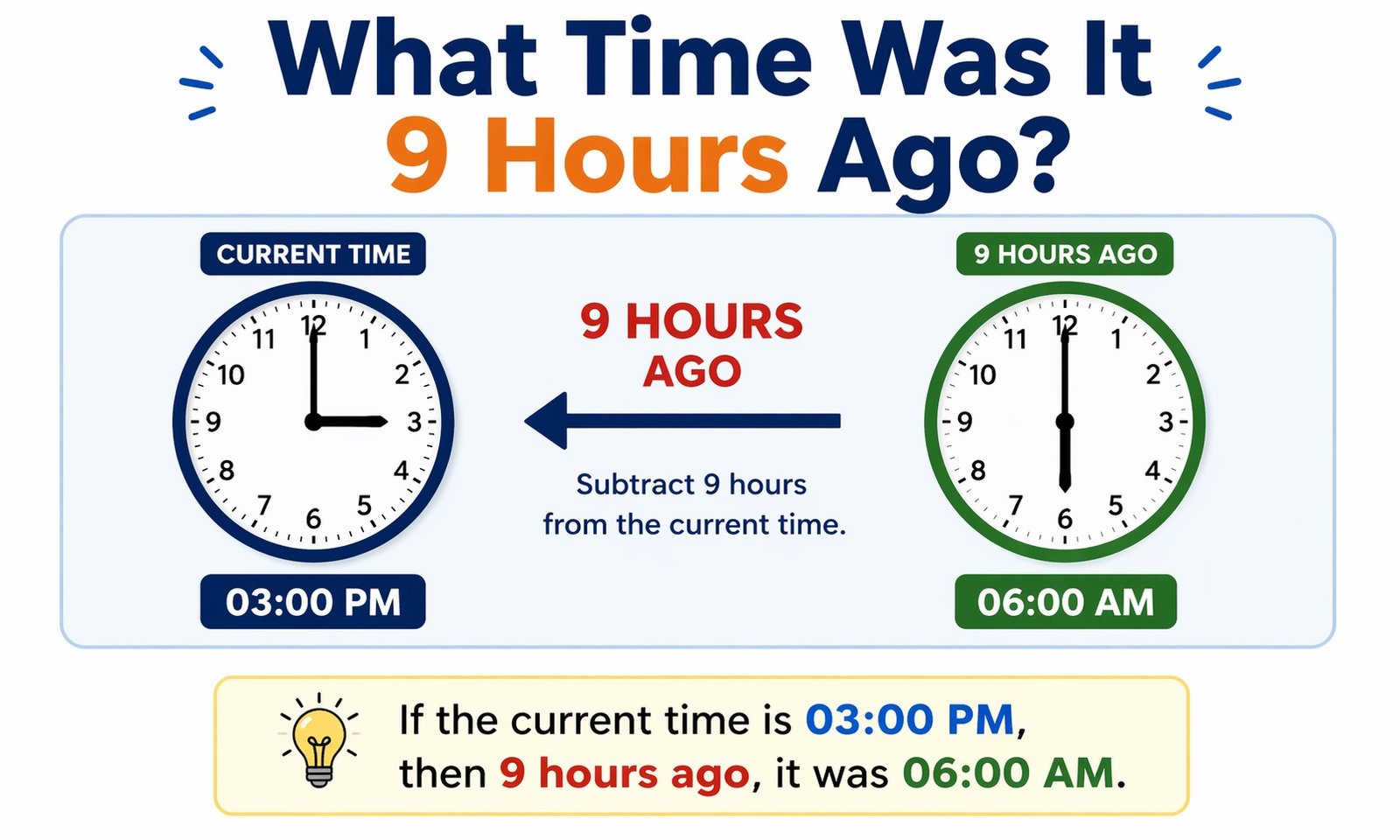
First, note the current time. For example, let’s say it is 3:00 PM.
Second, convert the time into a 24-hour format if necessary. In this case, 3:00 PM becomes 15:00.
Third, subtract 9 from the hour value. So, 15 minus 9 equals 6.
Finally, convert back to standard time if needed. 6:00 in 24-hour format is 6:00 AM.
So, if it is currently 3:00 PM, then 9 hours ago it was 6:00 AM.
This method works consistently and can be applied to any time of the day. If the subtraction results in a negative number, simply add 24 to adjust for the previous day.
Examples for Better Understanding
Let’s go through several examples to make the concept even clearer.
If the current time is 10:00 PM, subtracting 9 hours brings you to 1:00 PM the same day. This is because 22 minus 9 equals 13, which is 1:00 PM.
If the current time is 7:00 AM, subtracting 9 hours gives you -2. Since negative time doesn’t exist in this context, you add 24, resulting in 22, which is 10:00 PM the previous day.
If the current time is 12:00 midnight, subtracting 9 hours takes you back to 3:00 PM the previous day.
Practicing with these examples helps reinforce the concept and makes it easier to calculate quickly without confusion.
Why Time Calculation Matters
Time calculations are more than just an academic exercise. They are useful in many real-life scenarios. For instance, if you’re working with international clients, you may need to determine what time it was in another country several hours ago. Similarly, if you’re tracking sleep or work hours, calculating time differences helps maintain accuracy.
In professional environments, especially in industries like logistics, aviation, and IT, time calculations are critical. Even a small mistake can lead to missed deadlines or scheduling conflicts. That’s why mastering basic time subtraction is an important skill.
Dealing with Time Zones
One of the biggest challenges in calculating what time it was 9 hours ago arises when different time zones are involved. For example, if you are in Pakistan and communicating with someone in the United States, the time difference can significantly affect your calculations.
To handle this, you must first adjust for the time zone difference before subtracting the 9 hours. For instance, if there is a 10-hour difference between two locations, you must factor that in before calculating the past time.
Ignoring time zones can lead to incorrect results, especially in global communication. Therefore, always confirm the time zone you are working with before performing any calculations.
The Role of Digital Tools
While manual calculation is useful, digital tools have made time calculations much easier. Smartphones, computers, and online calculators can instantly tell you what time it was 9 hours ago. These tools are especially helpful when dealing with multiple time zones or complex scenarios.
However, relying entirely on digital tools can sometimes make you less confident in your own calculations. That’s why it’s beneficial to understand the logic behind the process, even if you use tools for convenience.
Common Mistakes to Avoid
Many people make simple mistakes when calculating time differences. One common error is forgetting to account for the previous day when the subtraction crosses midnight. Another mistake is mixing up AM and PM, which can completely change the result.
Some individuals also forget to convert between 12-hour and 24-hour formats, leading to confusion. To avoid these mistakes, always double-check your calculations and follow a consistent method.
Being aware of these pitfalls can help you become more accurate and confident in your time calculations.
Tips for Quick Mental Calculation
If you want to calculate what time it was 9 hours ago quickly in your head, there are a few tricks you can use. One helpful method is to break the 9 hours into smaller chunks, such as subtracting 10 hours and then adding 1 hour back.
For example, if the current time is 4:00 PM, subtract 10 hours to get 6:00 AM, then add 1 hour to get 7:00 AM. This method can sometimes be easier than subtracting 9 directly.
Another tip is to memorize key reference points, such as knowing that 12:00 AM minus 9 hours is 3:00 PM the previous day. These shortcuts can save time and reduce mental effort.
Real-Life Applications
Understanding how to calculate time differences can be useful in many situations. For example, if you’re trying to recall when you last ate or slept, knowing how to subtract hours can help you estimate accurately.
In travel scenarios, especially during long flights, calculating time differences helps you adjust to new time zones. It also plays a role in scheduling meetings, managing deadlines, and even planning daily routines.
The ability to quickly determine what time it was 9 hours ago can make your life more organized and efficient.
Frequently Asked Questions (FAQs)
How do I calculate what time it was 9 hours ago manually?
To calculate manually, subtract 9 hours from the current time. If the result is negative, add 24 to adjust for the previous day.
What happens if the calculation crosses midnight?
If subtracting 9 hours takes you below 12:00 AM, you move into the previous day and adjust the time accordingly.
Can I use a calculator or app for this?
Yes, many digital tools can instantly calculate past times, but understanding the method is still important.
Why is 24-hour format useful in time calculations?
The 24-hour format eliminates confusion between AM and PM and makes subtraction easier and more accurate.
Does daylight saving time affect this calculation?
Yes, in regions where daylight saving time is observed, it can slightly alter the calculation, so adjustments may be needed.
Conclusion
Calculating what time it was 9 hours ago may seem simple, but it involves understanding basic time subtraction, handling day transitions, and sometimes accounting for time zones. By learning the step-by-step method and practicing with examples, you can master this skill بسهولة.
Whether you’re managing your daily schedule, coordinating with people across different regions, or simply satisfying your curiosity, knowing how to calculate time differences is a valuable ability. While digital tools can assist you, having a strong grasp of the underlying concept ensures that you remain accurate and confident in any situation.
With consistent practice and attention to detail, you’ll find that calculating time differences becomes second nature, helping you stay organized and informed in your daily life.